“What’s Hot, What’s Not, What’s Next”

Posted by Paul Brindley
on June 17, 2014

Apparel News: Immediates and Final Fall Orders at LA Fashion Market – June 2014

The Los Angeles Fashion Market Week for Fall II/Holiday deliveries was held last week in the downtown fashion district, centered on the fashion buildings clustered around the intersection of 9th and Los Angeles Streets.

Following is the re-post of the Apparel News wrap article for the week.

Michael Stars mobile showroom outside Cooper Design Space

Michael Stars mobile showroom outside Cooper Design Space

The Fall II/Holiday deliveries are traditionally in October and November.

I felt that there was a noticeable buzz of activity in all the buildings. I am sure that this was warmly welcomed by the agents after the weaker than expected March Fall I market week.

The Fall I  market week comes at the end of a long Fall trade show circuit. Buyers have seen enough of the Fall releases by the time LA’s turn is up.

Plus LA is a knit driven market. Knits generally do not require the lead time to produce. Buyers can place orders closer to delivery which provides them additional time before re-ordering the existing brands they carry or committing to something new.

The continuing uncertainty in the economy that is driving the mediocre retail environment has changed many retailers buying habits. Some of the most significant of these are the preference of buying closer to delivery for future orders and the convenience of buying immediate goods depending on current sales floor needs.

From what I have been told, the strength of last week’s market was based on the shorter lead time buying and the need for immediates. The manufacturers and agents will take it however it comes.

Paul Brindley
paul brindley consults
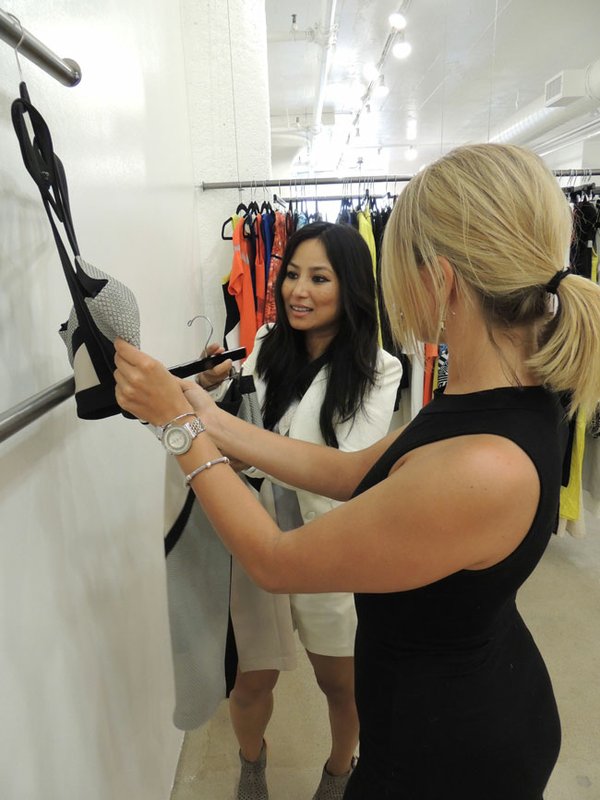


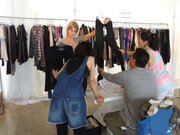
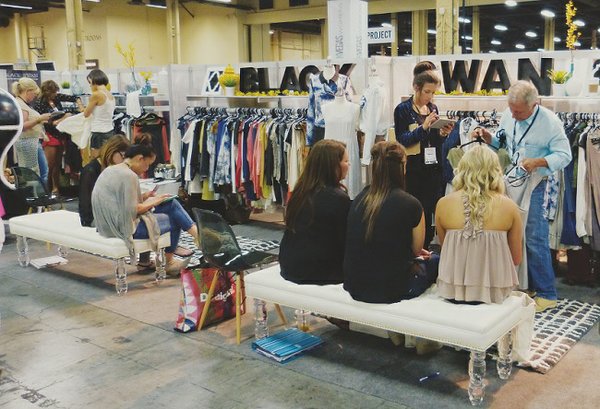
MARKET MEETINGS: Vishaka Lama of the New Mart’s ShowroomFive21 shows Australian dress line Lumier by Bariano to Colby Walksler during the recent Los Angeles Fashion Market.

MARKET MEETINGS: Vishaka Lama of the New Mart’s ShowroomFive21 shows Australian dress line Lumier by Bariano to Colby Walksler during the recent Los Angeles Fashion Market.

TRADE SHOWS

Immediates and Final Fall Orders at LA Fashion Market
photo

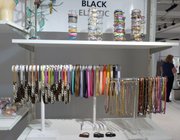
At Select, Miami-based accessories line By Lilla was doing well. The company’s hair accessories can also be worn as necklaces and bracelets.

photo

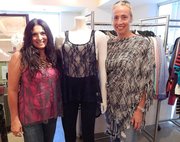
HALE MARY: Mary Cesario-Sofio wears the popular-selling Luxe Junkie lace top, and Haley Miller wears a popular Luxe Junkie poncho carried in their Hale Mary Showroom.

photo

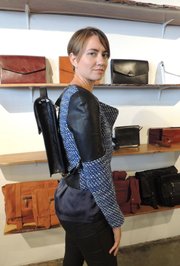
Paige Smith, the designer of Los Angeles–based accessories line Vere Verto, which made its debut at the Cooper Design Space during LA Market

photo

The Mary Joya Showroom, which recently relocated to the Lady Liberty Building, was showing the recently relaunched Trunk Ltd. line, as well as Artisan Deluxe, the new collection from the founder of Antik Denim.

photo

Los Angeles designer Anita Arze added new separates made from Modal and Tencel to her collection of high-end artisan sweaters handmade in Bolivia, which she showed at Designers and Agents.

photo

Hunter Richling (Wearing American Dress Code’s “Skinny Sailor” style) and Marie Shaffer (wearing American Dress Code’s “Mary Jane” style) at Designers and Agents

photo

With 21 booths, Brand Assembly was larger than its show last June. Retailers such as Ron Herman, Nordstrom, Nasty Gal and Gap Inc.’s Piperlime shopped the show.

Los Angeles Fashion Market was busier than expected for many showing at the California Market CenterThe New Mart, the Cooper Design Space, the Gerry Building and the Lady Liberty Building, as well as exhibitors showing at Designers and AgentsBrand Assembly and Select.

Some reported strong interest in Immediates as buyers replenished their inventories while others said buyers who had placed light orders for Fall goods earlier in the year were back to finalize and increase their buys.

Clicking at the CMC

June may spell gloom when it comes to the weather, but many showrooms at the California Market Center felt that the recent Los Angeles Fashion Market was anything but gloomy.

While buyers weren’t breaking down the doors, there was a constant stream of store owners filling in their inventories with Immediate orders while they were placing orders for Fall.

“It’s been a steady flow of stores,” said Joyce Snyder, national sales manager for the vintage-inspired women’s line Stop Staring! “The market for a June market has been good. I have opened some new accounts in Atlanta; Billings, Mont.; and Kansas City, Mo.”

Snyder made several appointments with existing customers, but new accounts wandered in to her second-floor showroom, strategically located near the elevators. The Fall/Holiday collection for Stop Staring! was invigorated with some bright new colors, such as peacock blue and jewel tones. Longer sleeves were making their way into the Fall/Holiday 2014 collection, whose wholesale prices average around $80.

The line, designed by Alicia Estrada, is popular for its 1950s-vibe dresses and because it is manufactured in the Los Angeles area. Snyder said just about every order included a peplum dress.

On the CMC’s third floor, Jenna Fisher, the manager of the Coin 1804 showroom, had seen bursts of business during the four-day market. Sunday was very busy, but buyer traffic had thinned out by Wednesday.

She said buyers were placing orders for Immediate goods. Doing well for the Coin 1804 line, headquartered in Los Angeles, were maxi skirts and tank tops. “We sell across the board, from young contemporary to misses.” Fisher said.

Even though Immediates were foremost on many buyers’ minds, Coin 1804 was previewing pre-Spring knit tops in gray, blush, white and black to get feedback before producing the line, mainly made in Los Angeles.

Matt Gill, head of West Coast sales at the XCVI corporate showroom for the California lifestyle clothing collection, said he was pleasantly surprised by the June market. “Usually, June markets are slow in anticipation of MAGIC in August, but this has been a great market for us. It is better than last March and last June,” he said. “There have been more sales, and new accounts are finding us.”

Not far down the hall at the Hale Mary Showroom, Haley Miller and Mary Cesario-Soflio saw buyers from some of the large stores they work. Reorder activity was fairly brisk. Particularly popular were faux-fur scarves, both long and short, for Fall, wholesaling for $15 to $19, and a one-size-fits-all lace swing top that wholesales for $13.

“It was not a negative Nellie market,” Miller said.

The New Mart: More specialty

For Eme Mizioch of the Joken Style Showroom, the Fall II/Holiday ’14 market was a revelation.

She forecasted a steady market, but foot traffic seemed up, and many buyers hailed from an unexpected source. She saw more specialty retailers than she had since the beginning of The Great Recession.

“I really thought that specialty was a dying breed,” she said. “But they seem like they were back, and they were buying pushed-out deliveries.” Texas-based Kalcorp Enterprises Inc., parent company of specialty chain Aggieland Outfitters, shopped at Joken Style as well as Sassy Prints, a retailer from Georgia.

Mikey Herlo, director of men’s sales for Cotton Citizen, a Los Angeles–based men’s and women’s collection where every garment is dyed by hand, said that market was great for his brand. It exhibited at the Cohen Showrooms in The New Mart. “Orders and traffic were up,” Herlo said. Retailers browsing Cotton Citizen looks included Ron Robinson and American Rag as well as representatives from various Japanese retailers and distributors.

Vishaka Lama of The New Mart’s ShowroomFive21 showed Australian dress line Lumier by Bariano. She had appointments with her regular clients, who viewed her Holiday dresses. “There’s always new people who walk in,” she said.

Liza Stewart of the Liza Stewart showroom in The New Mart’s suite 900 also noted greater traffic compared with the June 2013 LA Fashion Market. The showroom exhibited lines including Butterflyzebra and Only Hearts during the market.

Cooper: June is for beginnings

June may be the second quarter for many businesses, but it represented a new beginning for Andie Verbance.

On June 1, she opened the By Land + Sea showroom in suite 205 of the Cooper Design Space. It’s a co-op effort with the Agent Icon showroom. Verbance worked as a showroom manager at the Cooper for the past five years, and, by her account, she hit the ground running with her first show helming her own showroom.

Immediately after opening the showroom, she flew to the East Coast for some appointments. When she returned to Los Angeles, it was time for the market. “We had a great market. It was busy,” she said.

Perhaps it was a case of beginners’ luck. Like many markets, different showrooms fielded varying degrees of traffic and business.

For Michael Moshi of the Los Angeles–based Lauren Moshi brand, June was a market defined by steady growth. “Orders were as usual—nothing out of the norm—but overall, it was good,” he said. “Traffic was at the norm.”

For men’s showroom The Foundation, traffic was a bit slow because the market was focused on women’s fashions, said Brian Heslop, the showroom’s West Coast sales manager. However, the foundation’s eyewear representative, Michelle Mills, saw retailers such as RevolveBlack Market and American Rag for her client Super by Retrosuperfuture.

Lien Vets of the Noella showroom said the show was good, but she thought that buyers were not focused on new lines. Rather, they were embracing lines that had performed well for them in the past. Her showroom exhibited SB47, a New York–headquartered line that made its debut for Fall ’14.

Another line making a debut at the Cooper was Vere Verto, a multi-functional accessories line designed and manufactured in Los Angeles, said Paige Smith, the designer of the handbags, which also could be used as backpacks and fanny packs. “It’s still a new concept,” she said of her line. “This show was about educating the buyers.”

Low gear at the Gerry Building

Even though traffic was slow at the Gerry Building showrooms, a few new accounts were opened during market. Sunday was the busiest day of the four-day show.

“I did open a few new accounts, and my appointments came in, but I felt it was quiet. Yet the people who came were buying,” said Karen Kearns, whose ninth-floor Karen Kearns Showroom carries five clothing lines, including Ruiz by Yolanda coats, Olsen EuropeCiao Milano jackets and Amy Brill sweaters.

A floor down at the Impulse Showroom, owner Lori Marchand said the show was challenging because there really weren’t that many buyers wandering through the building. “Generally, June is a good market for me, but this one was definitely challenging,” said the showroom owner, whose lines include Ball of Cotton sweaters, Amma tops and Olivi’s lace dresses.

Solid business at Lady Liberty

Mary Joya relocated her Mary Joya Fashion showroom to the Lady Liberty just two weeks before LA Fashion Market. The new space is one floor up from the showroom forFree People, which Joya also represents.

The Mary Joya showroom represents Trunk Ltd., which recently relaunched, and Artisan Deluxe, the new collection from the founder of Antik Denim.

Trunk has already been picked up by KitsonDash and The Den, and Artisan Deluxe has been picked up by M. Fredric and Ron Herman.

“Our June market is about getting caught up with my accounts for Fall and Holiday,” she said. “People will come and revisit their Fall order—and beef it up because they find out that certain categories are selling.”

Joya said she saw buyers from Alaska, Hawaii, Colorado—“the whole West Coast”—as well as several Japanese accounts that she sees every market.

“We do appointments, so we know if it’s going to be busy ahead of time,” she said.

Many buyers weren’t ready to buy true Fall items such as sweaters and jackets until now, she added.

Joya’s showroom shares space with three other showrooms: The Bar, the Hanger Showroom and the McMillian Showroom.

Selena Slogar, owner and director of the Hanger Showroom, said she was expecting June to be a smaller market but said some buyers skipped Los Angeles market because many downtown LA hotels were already booked because of the E3 convention. Plus, for her retailers, Fall has already been booked.

The Hanger showroom carries Los Angeles–based Karen ZambosMinistry of StyleRinguet and Lola vs. Harper, both from Australia; and Shilla, which she described as her “under-$100” line.

Sabrina McMillan, owner of the McMillan Showroom, said buyers were looking for the “next, new, different—but at a good price.”

Buyers are also asking for Immediates, she said. “I’m selling leather more than anything. It’s been my shining star this market.”

McMillan carries Bel KazanBoxy T’s and Donna di Eleganza, as well as Suzywan Deluxe, a new jewelry line from Sweden.

Upbeat at Designers and Agents

The mood was upbeat during the June 9–11 run of Designers and Agents at The New Mart, which drew buyers from Fred SegalNordstrom and Anthropologie, as well as boutique retailers from California, Colorado, Texas, Kentucky, Tennessee, Minnesota and Alaska.

“The mood has been really good, really positive,” said Barbara Kramer, co-owner of D&A.

Anna Menitskaya of Los Angeles–based Mijo by Michelle Jonas said the first day of the show, in particular, was busy, although by the second day of the show, she had primarily seen only California stores.

“People come to see us from all over California,” she said.

Most retailers were asking for Immediate deliveries, Menitskaya said.

“That’s the need—to fill shelves right now,” she said. “It is a trend, to have the purchase date as close to delivery as possible. We produce domestically, so we are able to meet the demand, and we sell to small boutiques.”

This was the first time at D&A’s Los Angeles show for Juliane Camposano, owner of Brooklyn, N.Y.–based Rosel, a collection of natural, organic and recycled-fiber fashion made in Peru, New York and Los Angeles.

“It’s been amazing,” Camposano said.

The designer had tried to land West Coast orders by directly contacting retailers but found the setting at D&A much more successful.

“This [show] has been a much better opportunity,” she said.

Rosel was showing in D&A’s Green Room, the annual showcase of new ethical and sustainable brands. The section is open to brands that have never shown with D&A before, and many go on to participate in some of the larger D&A shows, Kramer said. In addition to meeting with buyers, the Green Room provides a place for these designers to meet and network.

“This is the opportunity for them to connect with other designers, so many friends and collaborations get made here,” Kramer said.

Returning D&A exhibitor Anita Arze was showing her Anita Arze collection of high-end artisan sweaters handmade in Bolivia. Wholesale priced from $224 to $284, the pieces have a relaxed, easy fit and a look Arze calls “casual luxury.”

“It’s not mass produced,” she said. “It’s that special heirloom piece in your closet you’re going to pass on to someone someday.”

This season, Arze introduced separates to go with the knits. Made in Los Angeles, the pieces are designed in eco fabrics such as Modal and Tencel.

Arze was showing her collection in a booth with Marie Shaffer, who was exhibiting American Dress Code, a new line from the former owners of Blue Cult.

The men’s and women’s premium-denim line featured novel details such as an offset hidden zipper on the “Mary Jane” jean or the cargo pockets on the “Skinny Sailor” style. In addition to denim, the collection features corduroy, sateen and engineer-stripe fabrications. Wholesale prices range from $89 to $129 for women’s styles with stretch and $119 for men’s rigid denim styles.

Shaffer, who previously ran the Tool Box showroom in The New Mart for many years, said she knew June market was one of the slower of the year but had appointments with Bloomingdale’s and Nordstrom.

Select opportunities

Traffic was light at the Select show, held June 9–11 in the CMC fashion theater, but exhibitors reported seeing a few key buyers.

Los Angeles denim line Grace LA has a showroom on the fifth floor of the building but also decided to show at Select.

Sales rep Beth Amoah said June is typically a slow month, but she met with local buyers as well as two from Canada and another from Colorado.

Grace LA is known for its embellished pockets and had several new designs, including an Aztec-inspired pattern in crystal.

This was the second time showing at Select for Miami-based accessories line By Lilla. The company makes hair accessories that can also be worn as necklaces and bracelets. The current top seller for the company is a leather hairband/bracelet made in Colombia, where the founders of the company are originally from.

Sarah Zane Moore, director of sales for the company, had just returned from markets in Dallas and Atlanta. She said the company had shown at Select in March and had an “incredibly fantastic” show.

“[This] show is not super busy, but we did just fine,” she said. “We need to do all the shows. If we build it, they will come.”

The accessories are wholesale priced from $3.50 to $18 for styles with antique lace, and all the pieces are handmade to order in Miami.

Brand Assembly celebrates milestone

The Brand Assembly trade show celebrated its first anniversary during its June 9–11 run at the Cooper Design Space.

More brands did business at the most recent show compared with its June 2013 show. There were 21 booths at the most recent Brand Assembly, compared with 15 booths at the June 2013 show, said Hillary France, co-founder of the show. However, whether the show hosts more booths or less booths is not important, France said. “It’s a tightly edited show, and all of the brands work together,” she said. “We want to make sure that buyers don’t feel overwhelmed and that brands have the time to work with the buyers and not feel rushed.”

She said retailers such as Ron HermanNordstromNasty Gal and Gap Inc.’s Piperlime visited the most recent show.

Jennifer Waycott, a sales rep for the Gorjana label, based in Laguna Beach, Calif., said the show went beyond her expectations. “Shows in June are more of an appointment-based business,” she said. “But we established new business through walk-ins,” Waycott said. Gorjana took more than 20 orders during the show.

Many of the vendors at the show, such as Anna Boggs of Los Angeles–headquartered line Rachel Zoe, said traffic followed a certain rhythm. “The first day was steady. The second day I was slammed. The third day was quiet,” Boggs said of the show.

Most of the vendors showed Holiday collections at the show. Some showed styles that had delivery dates of Dec. 30.

Posted by Paul Brindley
on April 30, 2014

E-Commerce and the Challenges for Fashion Manufacturers and Retailers

This is an informative article from Apparel news earlier in April on the challenges that the continuing growth of e-commerce on fashion manufacturers and retailers.

All of the issues mentioned in the article are currently being borne out in the US apparel market.

Paul Brindley
paul brindley consults

APPAREL NEWS

FINANCE

How Apparel Manufacturers and Retailers Are Coping With the E-Commerce Threat

By Deborah Belgum | Thursday, April 3, 2014

These are tough times for traditional retailers. Many big store chains and specialty stores are finding their business is being swept away by websites that make it easier for people to shop any time of the day or night without even moving from the couch.

The competition for sales is growing stiff with people downloading mobile-phone apps for shopping, browsing shopping sites via their tablets or computers, and saving time and gas if they don’t venture out to malls or shopping streets.

Goldman Sachs predicts that U.S. retail sales directly on smartphones will more than double from $70 billion this year to $173 billion by 2018. Similarly, tablet sales will more than triple from $130 billion this year to $453 billion in 2018.

Apparel manufacturers and others are finding that as retailers adjust their business models to compete with e-commerce, so must they.

What does the future bring? A number of financial experts shared their thoughts about how retailers are reacting to consumer shopping patterns and, in turn, how this is affecting manufacturers

With e-commerce playing a greater role in shopping and consumers still cautious about spending, how are retailers changing their purchasing patterns? Are they making smaller orders, asking for shorter delivery windows or doing more reorders? How are manufacturers adjusting to this?

Sydnee Breuer, Senior Vice President, Business Development, photoRosenthal & Rosenthal

The biggest change I’ve noticed in retailers’ purchasing patterns with e-commerce is having the manufacturer/importer/distributor ship directly to the consumer.

This creates many smaller invoices. And whether you use a factor to handle the receivables or handle it in-house, there is a definite cost involved with each invoice generated. So the smaller the invoice size, the more costly it is to process and handle the invoice.

With the supplier shipping direct to the consumer, it takes the inventory risk away from the retailer and onto the supplier, who must be sure they have inventory in stock to ship should an order come through via e-commerce.

Mitch Cohen, Western Regional Manager, CIT Commercial Servicesphoto

With an increasing number of consumers turning to e-shopping, many major retailers are making an effort to place a broader assortment of styles and sizes on their e-commerce sites as compared with their stores. These retailers also continue to look for ways to carry less inventory in spite of the consistent increase in online sales.

We are seeing manufacturers, on the other hand, ship on a consignment basis and/or hold inventory in certain cases where the manufacturer makes direct shipment to the consumer based on the orders that a retailer gets on their e-commerce site. Manufacturers appear to be willing to make these accommodations as it’s helping to increase their overall sales, and many are also investing in their own e-commerce sites.

Rob Greenspan, President and Chief Executive, Greenspan Consult Inc.photo

Many retailers seem to be placing smaller orders with much closer delivery dates. So far during 2014, for me, I have yet to see any significant patterns evolving for reorders.

The poor weather in the Midwest and eastern parts of the country and other economic factors have played their roles in an unpredictable first quarter. Time will tell the effect of the increasing e-commerce business and how, in the long run, this will play out for the manufacturers and importers of apparel.

On the manufacturing/importing side of the business, companies need to be cautious in placing their inventory orders for either finished goods or fabric. I have seen many companies upgrading their e-commerce websites as direct demand from consumers is becoming increasingly important to their business. Keeping pace with these changes can help a company grow its own e-commerce revenues, which in turn can increase the gross profit margins.

Overall, business conditions between retail and e-commerce are changing. The successful manufacturer/importer will need to keep up with these changes in both parts of their companies.

Nick Hart, Managing Director, Bibby Financial Servicesphoto

Tight inventory management at retailers remains critical for their success, particularly for those that operate a bricks-and-mortar model. You see the big chains increasingly active and driving increasing volumes on their e-commerce sites but also trying to divert some sales into stores, increasing footfall.

We are seeing smaller orders with subsequent multiple reorders. Some powerful retailers will demand a certain amount of on-hand inventory be held at the supplier. This puts significant pressure on the suppliers’ cash flow. There is a rise in product/celebrity exclusivity deals as a demand-led strategy helps to drive customers to either the stores’ physical locations or their website.

E-commerce retailers continue to gain ground from a volume perspective and are increasingly confident with their orders being placed. Online is no longer solely for off-price. As consumer confidence returns, consumers are increasingly willing to buy online at full price, provided that they are confident in the returns policy. This is giving rise to significant issues with serial returners.

Retailers are now employing analytics to tailor special product releases and offers to customers that have low return rates. Brands need to be careful of how the automatic-return policy is applied to their payments when dealing with online retailers.

Shorter lead times and rising wage rates in China are creating opportunities for manufacturers to make in the U.S. However, rising minimum-wage requirements and employer responsibility under the Affordable Healthcare Act are increasing the prices of domestically manufactured garments.

Locally manufactured product allows for shorter lead times fulfilling reorder strategies and significantly reduces the supply-chain risk for the supplier. Consumers have to be willing to pay a fair price for domestically manufactured product. Retailers have to allow that small increases in retail prices flow through to the manufacturers to pay for the increased labor costs rather than the retailers retaining the bulk of the increase. As ever, it is a delicate balance.

Sunnie Kim, President and Chief Executive, Hana Financialphoto

All retailers are under pressure to do more e-commerce. It is no longer the wave of the future but very much the present. We have seen certain big-box stores reduce either the number or size of their locations and devote more resources to e-commerce.

Most retailers appear to be keeping smaller inventories on hand, maintaining shorter purchasing windows and focusing on staple products while staying away from speculative items.

Therefore, manufacturers have had to adjust, conforming to the requests of retailers. This, of course, creates a ripple effect from their suppliers with respect to purchasing patterns, deliveries and seasons.

Dave Reza, Senior Vice President, Western Region, Milberg Factorsphoto

The growth in direct-to-consumer and business-to-consumer platforms continues to impact retailers and wholesalers (manufacturers/importers) alike.

Retailers benefit because e-commerce allows them to improve sell-through while reducing inventory investment.

Retailers are buying closer to the season, reducing the risks and cost of holding inventories.

Retailers can offer the same or a wider selection of styles/sizes on their websites without fear of not having the goods in stock.

Retailers can now rely on wholesalers to fulfill consumer orders for styles/sizes that are not “on the floor.”

Orders are smaller. Even one-off consumer orders are fed directly to the wholesaler.

Wholesalers gain an additional sales channel and “virtual” real estate with the retailer:

The wholesaler must carry stock SKUs in order to meet the requirement that they fulfill consumer orders quickly.

The wholesaler will have to do a good job of projecting the retailers’ needs so there is a selection of goods available close to season.

Conversely, wholesalers will have to have strong relationships with discount channels and flash sites in order to dispose of excess inventory at season’s end.

Both parties benefit from increased revenues, customer intelligence and, most importantly, customer satisfaction.

Paul Schuldiner, Managing Director, Business Development, King Tradephoto Capital

We have found that retail purchasing patterns have become more selective and conservative. The movement to a just-in-time model (unless the program is a “load in” order) makes the delivery window much shorter than the traditional importer/manufacturer has been used to.

This creates tighter cash flow as overseas production may still have to be placed with a longer lead time depending on the size and financial capacity of suppliers that are being utilized. This may create an opportunity for increasing domestic or near-shore production where these lead times may be more manageable.

However, the paradox to this is that one other trend with respect to holiday-season sales and Black Friday promotional sales is that the retailers are finalizing these orders no later than mid-September, which is in contrast to what we used to see several years ago. It used to be that we would see large purchase-order finance requests in late September and even early October.

The retail community has basically shifted to a purchasing model that concludes the purchasing earlier in the year in the attempt to better manage inventory. As such, clients are utilizing our financing earlier in the calendar year for holiday and Black Friday seasonal orders than they had done previously.

Ken Wengrod, President, FTC Commercial Corp.
photo

While monthly personal consumption is up, consumers are not spending at traditional bricks-and-mortar retail stores. When the economy builds steam, I believe the bricks-and-mortar retailers that carry a variety of consumer merchandise, from clothing to electronics, will be hit the hardest.

Bill Martin, founder of data firm ShopperTrak, which monitors 60,000 retail stores, notes that “we are in something of an evolutionary process where Americans are spending more online and becoming more careful about what they purchase.”

Data compiled by Reuters indicate department stores capture only $3.37 of every $100 of U.S. spending, the lowest since records were first compiled in 1991, when the amount was $9. Therefore, fewer dollars are being spent at department stores.

I strongly believe retailers need to first address their merchandising efforts. It appears some have lost their merchandising direction and have missed the fashion trends. The issue in this case is not just speed-to-market but having the right merchandise at the right time.

There is no doubt the bricks-and-mortar retailers are placing severe pressure on manufacturers to reduce the trade cycle and have inventory readily available. Further, if the goods don’t sell at retail, then the manufacturer will eventually take a hit and end up with excess inventory.

Astute manufacturers have been adapting to the changing times by switching their distribution patterns and selling more and more to online retailers, who use data to assist them in better buying projections, which greatly reduces the chance of a bad buy.

These manufacturers have found ways to shave off logistic times in their trade cycle, cut their unnecessary overhead and become streamlined in their own operation. It appears the online retailers have learned from the great merchandisers that the loyalty of a brand is not with the retailer but, instead, with the ultimate customer—the consumer. This is a belief the bricks-and-mortar retailers seem to have forgotten.

Paul Zaffaroni, Director of Investment Banking, Roth Capital Partners
photo

E-commerce sales of apparel have grown dramatically over the last five years while traditional retailers have seen their market share decrease.

Retailers that are achieving success in this environment have either invested in technology or people to provide an omni-channel experience or provide a compelling value proposition in terms of product offering or price.

Nordstrom, which is known for its customer service, invested in Bonobos and acquired HauteLook to broaden its offering and online expertise. Kate SpadeMichael Kors and Tory Burch have prospered by positioning themselves as “affordable luxury” brands initially focused on accessories or footwear, which are easier purchases for consumers in an uncertain economic environment.

The department-store channel continues to consolidate with Hudson’s Bay, acquiring Saks Fifth Avenue at the end of 2013, making this channel more challenging for manufacturers and brands to do business with.

Large retailers have more buying power and are ordering closer to need while demanding more flexibility from manufacturers and brands. Brands that are attracting the most interest from private-equity investors are less dependent on large retailers and have developed a closer relationship with their end customer through company-owned stores, e-commerce and digital strategies.

Nasty Gal and Warby Parker have achieved high valuations by building their brand and community online before opening their own retail stores. Large retailers will always be an important channel for many brands, but it’s important to adapt to the changing retail landscape by partnering with companies that have online expertise or hiring those folks at your company.

Posted by Paul Brindley
on March 13, 2014

Fall14 LA Fashion Market Week: The Trade Show Mediocrity Continues?

I have been meaning to write this article for weeks now but have been at a loss of what to say. If you know me, that doesn’t happen very often!

But with the Fall14 Los Angeles Fashion Market Week happening next week, I thought I would try and put my spin on the fashion trade show year so far.

Due to ice age weather in large parts of the country and the continuing struggles of the economy, the US fashion trade show circuit has been at it’s enigmatic best this year.

The year started with a optimistic bang at the Agenda show right here in dear old sunny and warm Long Beach, CA. You can check out my review article here.

Things then moved to the east coast and into the nastiest weather that many have seen in a while. Understandably, buyer traffic was down considerably due to the lack of dog sleds in New York. Quite sensibly, many buyers stayed away all together.

We then bounced back here to the ridiculously warm and dry winter in LA for the Summer14 edition of Market Week. I thought it was a quiet week but industry reports had the January market exceeding expectations for many agents. I didn’t see it myself, and I was in the fashion district every day.

I was bit surprised to read in Apparel News, “Some reported meeting with local, national and international retailers who were scrambling to replenish inventory. Others said holiday sales were good for retailers who carried higher-end merchandise.” I thought that holiday sales had been a bust all around.

Brooklyn Hat Co_Vegas Feb 14

Brooklyn Hat Co at Liberty in Las Vegas Feb 14

However, there was some good business done at D&A on the third floor of The New Mart. My old mucker, Ben De Luca of Christy’s Hats was very happy with the first 2 days; particularly the performance of his growing brand, Brooklyn Hat Co.

The road show then moved to Las Vegas for the madness that is the bi-annual Las Vegas fashion trade show week.

The results were choppy. The contemporary shows at the Sands Expo/Venetian Hotel were busy and bustling – Liberty, Agenda and Capsule.

The better men’s show MRket, the women’s contemporary and missy show Stitch, and Accessories did just OK.

Over at the Mandalay Bay, reviews were mixed about Project, ENK Women’s and PoolTradeShow. I know established collections and agents that did very well, others that thought is was OK, and others that were disappointed. It is not unusual to get the full range of responses. However, the preponderance of the latter two was a bit worrying.

If you want to browse my photos from Vegas and see some of the labels that I liked, check out my Instagram page: instagram.com/paulbrindleyconsults

It was a quick turnaround to the Fall14 New York trade shows. So quick in fact that a few friends had to red-eye to get there for pre-show meetings the day after Vegas finished.

Again, there were more mixed reports of buyer traffic and order writing at Coterie.

So, here we are with a few days to go before LA Market. It is difficult to predict how the week will go. Some of the agents I have spoken to are quite confident of a solid week based on their appointment calls and what they have heard from buyers.

louisefarnay_websiteslider

Louise Farnay bags

Regardless, it is exciting that one of my clients will be launching in the US this week. Hong Kong based Australian bag designer Louise Farnay debuts her Fall14 collection and immediates at Bloom Showroom in Suite 401 of the Lady Liberty Building at 843 Los Angeles Street. To view the collection, call or email Jennifer Dermer on 626-534-5625 or jennifer@bloomlashowroom.com.

I am optimistic that next week will be a strong LA Market Week. Why? No empirical reason, more a gut feeling.

I think that many west coast retailers have stayed close to home this year and have been watching their dollars in the continuing choppy market. Many are buying closer to ship date than ever before, and delaying their purchasing decisions out of prudence. But they have to plonk down the dollars some time for Fall.

I’ll be around the action all week blogging and Instagramming as I go.

Paul Brindley
paul brindley consults

Posted by Paul Brindley
on February 14, 2014

From Apparel News – Loving Las Vegas: Retailers Share Tips for Navigating the Las Vegas Trade Shows

Yes, I will be in Las Vegas again for my bi-annual walk and talk fest around starting Monday morning.

I don’t quite do the the 20 shows mentioned in the article but I’ll go close. I usually skip the sourcing shows so you can put me down for about 18.

The Vegas round of trade shows is the big kahuna of US fashion trade shows. It is hard to imagine that we need that many apparel options but obviously we do.

In the article, you will hear from a couple of people who I know, who I used to buy Wildlife Works from me in my days as National Sales Manager, who are long time LA retailers and who I respect –  Fred Levine of M.Fredric and Diane Merrick of the Diane Merrick boutique in Los Angeles.

I’ll be filing a full report on my website early the following week, and blogging and posting all week as I go.

All around it has been a very unusual start to the year in the fashion world. The retail side continues performing slowly after a soft holiday season. The wholesale side has been convulsed by the arctic weather in the east that have made getting to the trade shows Iditarod-ian … Mush!

My agent contacts tell me they are seeing demand for immediate goods as buyers fill in on orders they were wary of writing during the Spring14 wholesale selling season last year. And many buyers have skipped the east coast trade shows because of the weather.

So it is shaping up as an interesting week. I expect strong buyer traffic but wonder how far out they will be willing buy given the continued chop on the economy.

All will be revealed by this time next week, Dear Reader. Keep your eyes on this space.

Paul Brindley

paul brindley consults


RETAIL

Loving Las Vegas: Retailers Share Tips for Navigating the Las Vegas Trade Shows

By Andrew Asch | Thursday, February 13, 2014

With 20 apparel, footwear, accessories and sourcing trade shows taking place in Las Vegas market at the same time in February, thousands of brands are competing for attention, and the ambiance can be thrilling, festive and, ultimately, exhausting.

From the massive MAGIC Market Week—including MAGIC Men’s,WWDMAGICProjectPooltradeshowFNPlatformWSA@MAGICENK Vegas, the Tents at ProjectProject MVMNT and Sourcing at MAGIC—toMRketAccessories the ShowStitch, which was part of Modern Assembly—which also includes LibertyAgenda and Capsule—to CurveNVWomen’s Wear in Nevada (WWIN), Kidshow and the OffPrice show, there is a lot of ground to cover.

California Apparel News asked retailers who have been going to the show for decades for advice on how to survive the show, how the week has changed over the years (MAGIC was headquartered in Los Angeles during the Reagan administration) and what is next for fashion.

Giving memories and much-needed advice are Fred Levine, co-founder and menswear buyer for the M.Fredric chain of boutiques, which is headquartered in Agoura Hills, Calif.; Colleen Winter, founder of Chico, Calif.–based e-commerce emporiumLulus.com; Don Zuidema, co-founder of West Hollywood, Calif.–based boutique and fashion line LASC; and Diane Merrick, owner of the Diane Merrick boutique in Los Angeles.

How long have you been going to MAGIC? How has it changed?

photo

Fred Levine

FRED LEVINE: I’ve been going to MAGIC since the early ’80s, when it was a men’s apparel show. I was strictly a women’s apparel retailer at the time but found it important to check out the trends in designer denim lines. They were just emerging at that time—lines likeJordacheSassoonChemin de Fer, etc.—and the MAGIC men’s show was the only place to see them all under one roof. More than 30 years later, I’m still attending!

The show evolved from a limited men’s exhibition to a full apparel and accessories show for men, women and even kids. As an apparel retailer, I feel that if there is one show to see, it’s this one. It’s so complete and covers every aspect of product and retailing needs. Even without leaving paper at the show, a retailer can get a feel for the buzz in fashion, what designers seem to be breaking out and what direction is being taken in denim, skirt lengths, jumpsuits, dresses, etc. You can walk the various shows and almost by osmosis take in a “feel” for what seems to be trending. And now, with the cutbacks mandated by a tough economic climate, it’s possible to cut down the travel dollars and the time commitment to one grand show. Lisa [Levine, partner and womenwear buyer at M.Fredric] and I no longer find it mandatory to make trips to Europe and New York since we feel that MAGIC gives us enough exposure to trends. In a few days we come back home filled with a handle on what’s happening in our industry.

COLLEEN WINTER: I’ve been going to MAGIC for 18 years, since 1996. It has really gotten bigger. There are all of these shows-in-shows. Instead of just having MAGIC, there is FNPlatform, ENK, Pool, Project, —there seems to be so much to see! It makes it hard for a buyer to see everything. Combining shoes with clothes is the most difficult for us. We have to carve out time for MAGIC’s footwear show, WSA, as well as Platform, and we still see all the apparel.

photo

Don Zuidema

DON ZUIDEMA: Probably since the mid-’80s. It was the first MAGIC show at the Los Angeles Convention Center. They had the bubbles in the parking lot—similar to what Project is doing now with The Tents. Big, white, inflatable structures made out of vinyl fabric at the convention center. As the show kept growing, they kept building these bubbles in the parking lot. There wasn’t Pool, Project. There weren’t any sub shows. Now the producers of the shows set themselves apart, improving on what they do, so there is uniqueness to what they do. That is how they appeal to retailers.

There have been so many new shows that have come along. It has increased competition among shows. Each show elevated itself to respond to the current market, and the ways that shows merchandise themselves has considerably improved.

DIANE MERRICK: About 30 years. … MAGIC was one great big huge show in the Los Angeles Convention Center. I remember that they were obsessive about moving to Vegas. They wanted to move to Vegas because it was the better venue. There was more glitz and glamour. There were more things to do at night.

It was a men’s show and eventually brought in women’s. It wasn’t great, not until WWDproduced the WWDMAGIC show. But the whole ball didn’t start rolling until Project came in. They got hip lines; it became more of a place to go and see. MAGIC, Project and ENK are very upscale.

What shows do you shop?

FRED LEVINE: We try to cover as much as possible. We start at MAGIC to see some of the juniors trends that seem to be influencing the entire women’s apparel direction. Then we visit ENK to see many of our existing vendors to see what they’re coming up with for the following seasons. Then we do Project to see an amazing array of men’s product and hopefully find some new resources. Men’s product is slow to change so if we come across something new and exciting at the show, it pays the price of admission by injecting our men’s collection with something fresh.

DON ZUIDEMA: Liberty Fairs, Project, Curve, MRket, Capsule, MAGIC and Agenda.

photo

Diane Merrick

What shows do you shop?

DIANE MERRICK: MAGIC twice a year. There is Pool, MAGIC, Stitch. I also go to JCK in June. It’s the big jewelry show in Vegas. It is breathtaking. They have bowls of diamonds, rubies on the counters, but you almost have to give your first born to get into the shows. You have to show invoices, a retail lease, a valid driver’s license and resale numbers. If you bring a friend, you have to go through the whole thing over again.

Vegas seems to encompass everything, but Fashion Market LA has everything, too.

How do you pace yourself and not get exhausted?

FRED LEVINE: We pace ourselves by resting up for the big week and then force ourselves to take breaks for meals even if we are on a roll and don’t want to stop. We’re both in pretty good physical shape, so that helps—especially when we slide on our running shoes for what amounts to a fashion marathon. Advanstar, which owns and manages the show, has been amazing in helping out at this challenge of covering it all in a few days. They have a program set up for retailers who own larger-sized chains—we’re probably the smallest of the group. It’s called MAGIC Select. This program offers us airport transportation and transportation to and from the different show venues. They also assign us a concierge who makes sure we are well taken care of with our hotel reservations, entertainment and other needs. Advanstar really has made our trip so low maintenance that the stress and hassles of travel are pretty much eliminated so that our energy isn’t sapped. Makes sense from their end, too, because they wind up with retailers who are more energized and welcome the trade-show week instead of dreading typical out-of-town hassles.

If we pace ourselves right, we can enjoy the nighttime dinner dates or vendor parties. Lisa and I really enjoy spending some personal time with our business partners, some of whom we have known for more than 30 years. We love our industry and the personalities. MAGIC is the one time we can experience the lighter side and share good times with the others. Having fun is so important to a fulfilling experience in this tough industry and in such challenging times. We try not to overlook this, and MAGIC gives us this opportunity.

COLLEEN WINTER: We go to a lot more regional shows to make sure we don’t miss on a brand and to make sure that we see everything new. We also like to order close to our ship dates. During the last month, we’ve tried to see as many vendors as we could before MAGIC, so we could get our orders in. Otherwise, we might miss them at MAGIC. It is too big, and trying to do clothes and shoes, by the time you throw in ENK and Project, it is too many things to see. We dress comfortably because it is all about business for us. It is comfort first, fashion second. We get there at the moment MAGIC opens. We’re always the last ones to leave, when everyone is closing their booths and turning off the lights. We need every second. Every time we hit a new booth, we split up and each take a section, then we come back and discuss. We know to make decisions quickly. We know right away if something it going to be a super seller. A lot of people tell us that we’re the most efficient buying team. We know exactly what the Lulus girl wants. We know who our customer is. When you don’t know who your customer is, you’re trying to please everyone.

DON ZUIDEMA: I can think back to a few years ago, when I took assistant managers to the show, they all thought it was fun and there were a lot of pretty booths. But three-quarters through the day, they ask, “How do you do this?” It’s about pacing ourselves. I map out what I’m going to do during the shows. I plan my day rather than be scattered.

Shoes always have to be comfy, something that will work well with concrete floors, and do well with walking—it is a priority. I’ll wear some great Nike shoes (one is called the Lunar, one is called Free) because they are really comfortable.

DIANE MERRICK: I wear sneakers. When I get to shows, I lose track of time. I don’t get tired. The minute I hear there is a show, I’m off and running.

What fashion trends will we be seeing in fall?

FRED LEVINE: I wish I had a clear answer for this, but I’m sadly at a loss. There has been a lot of sameness in the past few challenging years, so we haven’t seen much freshness from the contemporary designers. Maybe because they’re playing it safe these days? But we remain optimistic and hope that the recent modest recovery will uncover some risk taking by the designers and possibly charge the consumer with a reason to buy and change out what’s hanging in their closets.

We’re hoping that we see someone taking the reins with body design, color, fabrication or something that will pop! Then we can bring it home to our customer and present an exciting Spring/Summer collection in our stores. We need “Wild! Fresh! New! Fun!” so our customers can find the must-haves to express themselves and their optimism going into healthier economic times.

photo

Colleen Winter, right, with her mother, Debra Cannon

COLLEEN WINTER: We really are interested in statement coats this year. We’re also going forward with plaids, midi lengths and prints. We’re into slouchy sweaters. It’s something we did well with last year. We’ll go with asymmetrical slits and skirts this year, maybe some menswear as well. We try to buy as close to the ship date as possible since trends change quickly. We don’t like to buy far out.

DON ZUIDEMA: We’re seeing denim. It is not as strong as in the past, [but] denim is slowly coming back. We’re seeing some great knits, some great sweaters and jackets. Also trending are some technical fabrics, comfortable pants and sweats. There is a lot of emphasis on technical fabrics, but they are being bought in the contemporary market.

DIANE MERRICK: We’re positive with everything that has to do with leggings, flowing tops, a lot of cashmere, beautiful fabrics. Everybody is looking for loose, wonderful pants with a great look. Jeans have really fallen off. I don’t see ladies asking for jeans. But things can change in five minutes.

How do you prepare for the Las Vegas shows? Do you do any research beforehand?

FRED LEVINE: I prepare by just observing what people are wearing in the streets in Hollywood, Santa Monica, Venice, Silver Lake and some of the trendsetting areas of LA. I can get a better handle on the latest looks in denim, dresses, slacks, accessories, etc., by studying what clothes people are shopping in and dining in instead of what’s on the shelves of the leading retailers or in the magazines. Maybe not too scientific, but it’s worked for us over the years. Being married to my buying partner, Lisa, and being big brother to M.Fredric’s kids’ buyer, Mardi Fox, and scouting fashions with them makes it a nice and an easy way to study the fashion scene on the streets of LA!

COLLEEN WINTER: A month and a half before MAGIC, we set appointments for vendors going to the show. We see the lines before MAGIC. We try to see as much as we can before the show. It gives us more time to seek new vendors.

With long-term vendors, we’re meeting with them almost every week. MAGIC is the time to meet new vendors. We do leave time to walk the rows. We love finding new companies. I wish there was more time. We barely stop for lunch; we bring lots of nuts. The best is high-powered protein nuts, usually almonds.

DON ZUIDEMA: I try to plan out—I got four days to try to plan out what shows I can attend in those days, and in those days I’m accumulating information and making a list. I also don’t make appointments. I do “stop-bys”—I’ll stop by and take a look. I’ll walk the shows and see people I’m not familiar with. We need to keep being challenged and see what is going on.

Part of it is being there, it is just inspiring, seeing a lot of great ideas, talking to fellow retailers and friends in the industry. They give some insight. In some way, it’s a chance to be inspired by the others. You never know what you might find around the next corner.

DIANE MERRICK: Just magazines and the Internet. I like to be surprised. I don’t like to have preconceived notions before I get to the shows.

Posted by Paul Brindley
on January 21, 2014

Agenda Long Beach Gets 2014 Fashion Trade Show Year Off On Right Sneaker

Agenda January 2014

The 2014 fashion trade show roundabout go off to a strong start with the Agenda trade show at the Long Beach Convention Center from January 7 – 8 in downtown Long Beach, CA – my long time US domicile.

With more than 700 brands exhibiting, Agenda continued it’s impressive year on year growth. The enormous space was jumping with energy and activity. It was obvious that buyers were dropping paper and not just warming up their trade show stylings for the year ahead.

The Puma booth on Tuesday

The Puma booth on Tuesday

Most brands were showing their full Fall14 collections with Spring/Summer 14 available for immediate goods or fill-in ordering.

Agenda is primarily a men’s lifestyle, action sports and streetwear showcase. Market leaders such as Puma, Adidas, G-Shock, Mitchell & Ness, New Era, O’Neill, Vans backed up again. Agenda has an excellent record in retaining and adding marquee brands.

There were also many interesting smaller, more contemporary labels on show. I’ll get some of those later.

The women’s contemporary fashion section, AgendaWMNS which debuted at last July’s edition, nearly doubled it’s brand participation to about 60 exhibitors.

Tuesday, the first day, was the busier of the two. The drop in activity was explained by Surf Expo in Orlando commencing on January 9. The compression of the shows is nothing new. There are so many on the calendar these days that many wholesalers are skipping shows they used to do to concentrate on those they feel they have to do. This is particularly true in the first quarter of the year. E.g. some brands will skip the Las Vegas round of shows in February and move straight on to New York.

I don’t wear caps very often but have a well selected collection for when I do. I like to check out my favorite manufacturers when I can. At Agenda, there were 3 – American Needle, New Era and Mitchell & Ness.

American Needle 40's style range and bill treatments

American Needle 40’s style range and bill treatments

John Faul of Red Zone Agency distributes American Needle caps. They had an excellent 2 days working important accounts like Kitson, Tilly’s, Vertigo in TX, and Swagg in AZ. John slung me one of their promo logo caps at Agenda last August in Vegas. They are a great fit with a deep comfortable crown and a rigid bill.

This season, American Needle is showing a 1930’s/40’s inspired range based on the the Jackie Robinson biopic,  47. 

Bill treatments, prints and patterns are going strong.

Mitchell & Ness were also showing a combination of retro styles and contemporary logos with bill treatments. I love the ’80’s San Diego Padres jersey that they had at the front of the booth. There just is something about those 80’s “pajama” type baseball unis – the Padres, the Astros and the White Sox are my particular favs.

The 80's "pajama" Padres uni at Mitchell & Ness

The 80’s “pajama” Padres uni at Mitchell & Ness

New Era was showing their non-license, house range. The graphic and pocket tees, hoodies, sweatshirts, crew neck sweaters, quilted outwear with shooter patch that are designed to wear alone or to merchandise back with licensed pieces are well priced at $15 wholesale for the tees through $45-50 for the jackets.

Over on the more fashion aisles, I came across Coalatree Organics.  Coalatree is a much a movement as a fashion brand. Take the time to go over their website.

The majority of the garments are made from organic or recycled materials. The jackets, tees, tops, pants, shorts and caps are well priced at wholesale with tees at $13.50, shirts $35-50, jackets $40-65, and caps $16.

Coalatree was busy both days working accounts like Karmaloop (their biggest account), Kingswell in Loz Feliz and backcountry.com.

Eme Mizioch, the west coast agent for fun, bright Australian label, TeeInk, was very happy with the buyer activity. The TeeInk tees at $15-17, pullovers at $21-23, button downs at $35 and shorts at $26 retail strongly in beach and resort towns, and anywhere the sun is shining.

TeeInk from Australia

TeeInk from Australia

The California label, Katin has been around since 1954. The designs of it’s cool, relaxed look for men and women are based on the brand’s history. The Creative Director/Designer, Jason Rodriguez takes inspiration from news articles, photo shoots, media exposure over the years and ties them all back into a surf look that has stood the test of time. The snapback and camper caps, and jackets made of board short material are a great idea that are sure to retail strongly.

Katin

Katin

Agenda keeps going from strength to strength. I won’t be at the NY edition this week but will be at the Vegas show in mid-February. Agenda was one of the busiest of the August round of Vegas shows. By the looks of things they will not trouble keeping it up.

Paul Brindley

paul brindley consults

Posted by Paul Brindley
on December 19, 2013

U.S. Retail Sector: Where to from here?

There has been some predictably disappointing news from the retail sector so far this holiday sales season. I mainly track and report on fashion retail sales. However, this time of year I take significant notice of retail sales performance in general as an indication of disposable income spending that is so vital to the fashion industry.

As I sat down to start this article, this just came in on Yahoo.com from the AP in an article titled: Holiday shopping season: A disappointment so far

Sparse crowds at malls and “50 percent off” signs at The Gap and other stores offer clues as to how this holiday season is shaping up so far: It’s the most discount-driven one since the U.S. was in a deep recession. It’s also the most disappointing for stores.

Sales are up 2 percent to $176.7 billion from Nov. 1 through Sunday, according to data provided to The Associated Press from store data tracker ShopperTrak. That’s a slower pace than expected with days left in the season. ShopperTrak’s predicts sales will rise 2.4 percent to $265 billion for the two-month stretch that’s typically the busiest shopping period of the year.

The modest growth comes as the amount of discounts that stores are offering this season is up 13 percent from last year — the highest level since 2008, according to financial services firm BMO Capital Markets, which tracks 20 clothing stores.

It is apropos that the AP references the 2008 Recession because that is where I planned to start.

The global financial crisis of 2008 has a few monikers depending where you come from. In many parts of the world it is known as “The GFC”. In others, “The 2008 Crash”. Here in the US, it’s just plain “The Recession”.

If you were living in the US at the time, you will never forget it. As the actor William Hurt says in his portrayal of then Secretary of the Treasury, Henry Paulson in the 2011 movie “Too Big To Fail”, “You want too big to fail? Here it is!”

I was a Commercial Banker in a previous life. The bank I worked for was the subject of unfounded rumors of financial weakness in the early ’90’s. Our office was above a branch of the bank. There I witnessed that unique and unforgettable phenomenon, a bank run.

The visceral human panic of a run has to be experienced to fully comprehend. All common sense and logic leaves, replaced by a palpable fear and anger.

You could feel something like that panic in 2008. Peoples’ financial security was disappearing before their eyes, the entire financial system of the largest economy on earth was teetering, and took an enormous, unprecedented injection of public money into the private financial system to eventually stabilize the system before the unthinkable.

I was living in Japan during the 1990’s when the effects of the bursting of the financial bubble in ’91 started to set in. Japan is only just starting to slowly pull out of the subsequent economic malaise. Only just, after 20+ years.

What has all this got to do with the current state of the US retail sector; everything.

It has been laughable to listen to the critics of the current Obama administration complain that he hasn’t “got the economy going again”. The recession might be technically over but we will be dealing with the effects for a long time.

I remember speaking with someone during the ’08 presidential campaign and saying that I thought that even if Obama won two terms, we would still not be through to the other side. Unfortunately, my prescience is looking like an unwanted ability.

Add that there has been so much gridlock and enmity in Washington throughout the Obama administration, it is not surprising that little substantive positive impetus at the national legislative level.

We have a long way to go before we see anything like a healthy and thriving retail sector in the US. And when I say “healthy and thriving”, I mean one supported and sustained by actual disposable income and not poisonous credit. The good thing is that I believe many people have learned the lessons of the credit madness that led up to 2008.

from the Hartford Courant - September 16, 2009

from the Hartford Courant – September 16, 2009

Disposable income is dependent on steady employment levels, and job and income growth. We just aren’t there yet by a long stretch. Hence, the tepid holiday sales activity.

As a consequence, it has been reported that stores are discounting deeper earlier this year. It always has to be remembered that sales do not equal profits. If you are giving away margin for the sake of ringing the register, it can come back to bite.

It also needs to be remembered that these are not just numbers. This is the time of the year when most retailers make the bulk of their money. 20 to 40 percent of yearly sales for small and mid-sized retailers take place within the last two months of the year according to the National Retail Federation (NRF).

Even though ShopperTrak tells us that 90 percent of U.S. retail sales are projected to occur in brick and mortar stores, the ongoing weak retail numbers and the meteoric rise of online shopping must be putting the bricks and mortar small business retailer under enormous pressure.

Here’s more from the trade papers over the past month:

  • Sales during Thanksgiving weekend and Black Friday, which is considered the traditional start of the holiday retail season declined 2.9 percent compared with last year, to $57.4 billion. It was the first time that happened since 2009, during the height of the Great Recession, according to the NRF.
  • Online retail sales soared and broke records. E-commerce sales on Black Friday skyrocketed to $1.198 billion, which was a 15 percent increase over last year, according to comScore Inc., a Reston, Va.–based company that analyzes e-commerce sales. It was the season’s first billion-dollar day, according to comScore.
  • Jeff Van Sinderen, retail analyst for financial firm B. Riley & Co., forecast that retail sales will perform anemically from 1 percent to 2 percent. However, he considered it a decent performance in light of all the pressure retailers have been working against.
  • Stubbornly high unemployment numbers and falling wages across the American economy made people cautious, said Kimberly Ritter Martinez, an economist with the Los Angeles County Economic Development Corp. “People were out there shopping,” Ritter Martinez said of the Black Friday weekend. “But they made budgets for themselves, and they’re sticking to them. They may have money, but they are hesitant to spend.”
  • It also was a Black Friday weekend when a lot of people don’t have money. The unemployment rate for the U.S. is 7.3 percent and 9.5 percent in Los Angeles County, according to the Bureau of Labor Statistics. If all the people who stopped looking for work are counted, the number is 13 percent of the U.S. population.
  • America’s Research Group’s consumer survey found nearly half of consumers are looking for 70% off or more in their last-minute shopping trips.

So, where to from here for US retailers? The answer is online. And more specifically the on mobile devices and on social platforms.

internetretailer.com reports that:

The mobile revolution has reached another milestone: Consumers now spend more time interacting with online retailers on smartphones and tablets than they do on desktops and laptops.

55% of all time spent with online retail in June 2013 occurred on a mobile device, finds web and mobile measurement firm comScore. 45% occurred on desktops and laptops. Specifically, smartphones accounted for 44% of retail Internet minutes while tablets accounted for 11%, comScore says.

Retailers need to make sure their websites match the look and feel of their businesses, are kept updated, have all the functionality required, are responsive and SEO’d to perfection.

As for social media, there is so many platforms that the trick is to pick three or four that best suit the business and work consistently on those.

A basic four platform strategy would be: Facebook, Twitter, You Tube, and Instagram or Pinterest. These can be linked so that content is automatically posted contemporaneously and instantaneously.

Drive business to your website with new, fresh content flowing through these channels that lets your prospective customers primarily know who you are rather than what you are selling.

Bricks and mortar retailers must have effective online strategies to survive. There is just no way around it.

There will be no going back to way things were. The online shopping evolution has taken care of that reminisce.

As for overall shopping activity, we are going to have to just ride out the ongoing reverberations of 2008 until the disposable income is there to support a healthy circulation of the money supply.

Today’s news that The Fed has begun a tapering of its extraordinary bond purchases which have flooded the United States and the world economies with over $US3 trillion of cheap capital since the GFC is great news. It is a significant step towards the world’s largest economy finally leaving 2008 behind.

Paul Brindley

paul brindley consults


Posted by Paul Brindley
on December 11, 2013

WWD.com – Facebook Ranks as Top Platform in Social Media Survey

There are some very interesting social media usage stats in this article on today’s WWD.com.

According to the survey, Facebook is the most trusted for brand recommendations.SM icon from website

What I find interesting is the personal connection to both the information givers and the stories that they tell. People trust those closest to them; no surprise there. But the fact that the research shows that people want to hear personal stories about product and service recommendations from their friends and social circle rather than from bloggers and experts is refreshing, and something that was predicted to change by the advent of social media.

This sea change in product marketing should also be exciting for brands because it shows the value of direct engagement with their customers. Brands should be spending at least as much time on strategies that generate authentic feedback (positive or otherwise; remember to keep it real in social media) from their customers as cultivating bloggers and seeking industry validation.

Paul Brindley

paul brindley consults


December 10, 2013

Facebook Ranks as Top Platform in Social Media Survey

When it comes to product and service recommendations, Facebook scored highest as the most trusted platform, according to a new survey conducted by Social Media Link, an advocacy activation company.

Some 10,337 people who are active in social media were surveyed online. Ninety-three percent were women, and 70 percent of all respondents were between the ages of 25 and 44.

The survey found that 68 percent said they trusted Facebook over blogs (63 percent); retail Web sites (63 percent); Pinterest (56 percent); YouTube (51 percent); Twitter (41 percent), and Google+ (41 percent).

“During the holidays when everyone is looking for trusted information on what to buy, recommendations from your social circles on Facebook will carry the most credibility,” said Susan Frech, chief executive officer of Social Media Link. “Undoubtedly, the survey found that people don’t need hundreds of recommendations and reviews to entice purchase. It’s really about receiving a quality message from a trusted source.”

Jordan Herrmann, marketing director of Social Media Link, added, “The data we found showed a few points that we believe demonstrate how recommendations from Facebook friends can drive transactions. The results showed that Facebook is the most trusted platform, and, when it comes to making an actual purchase decision, friends and family were ranked as having the highest impact. When thinking about your Facebook social circle, friends and family are an enormous part of it, if not all of it.”

According to the study, reviews by friends and family have the biggest impact (86 percent), followed by professionals (58 percent); Web site reviews (54 percent); acquaintances (42 percent); bloggers (39 percent), and celebrities (11 percent).

Herrmann explained that the reason Facebook has the most impact is because the network is one of the most closed, where relationships are valued. The implication for brands, she said, is that they may be missing the opportunity to use small social circles because brands often focus on bloggers and influencers in social media. However, the study showed their opinions may carry less weight. The idea isn’t to discount bloggers, which she said are so important to fashion, beauty and luxury, but rather to explore the huge additional opportunity to leverage social recommendations through an individual’s social circles and to implement this tactic with scale.

Forty percent of those surveyed said the most valuable reviews are those that contain personal stories, rather than a list of product benefits, which were most valuable to 34 percent. Star ratings are less influential; just 15 percent said they’re the most valuable in influencing purchases.

People trust online posts and reviews most for household products (23 percent); personal beauty items (18 percent); electronics (16 percent), and restaurants (15 percent), according to the survey.

According to the study, people trust product recommendations from people they know (92 percent), more than e-mail (50 percent), TV (47 percent), print (47 percent), outdoor ads (47 percent) and radio (42 percent).

The survey examined why people share their opinions online and found that a positive experience with a brand was the primary driver of online reviews. Some 78 percent said they shared their opinions based on their experience. Less than half, 47 percent, said a negative experience prompted a review. Forty-six percent said they like sharing their opinions with others, while 43 percent said they shared opinions online to help inform others.

Finally, some 77 percent of those surveyed said they needed to see less than 10 reviews to prompt them to make a purchase.

Among the key takeaways are that rather than focusing on the overall number of recommendations for one’s brand, one should concentrate on how to generate content that will have the strongest impact. In addition, brands should focus on encouraging their consumers to share personal stories, mobilize advocates to share within their close social circle, and look for those who have had a great experience with one’s brand, according to the survey.

Posted by Paul Brindley
on November 27, 2013

Apparel News: Business-to-Business Technology Solutions for Fashion Are Gaining Traction

In this article, Apparel News speaks with the leaders of the burgeoning B2B technology services that are revolutionizing the way the fashion industry has conducted business for 100 years.

The fashion industry was slow to the technology party. When I was first involved in the US fashion industry in 2000, many players in the market didn’t have email addresses, let alone websites.

Still now, many manufacturers, wholesalers and retailers are skeptical of the new technologies. The business of the business has been done the same way for so long that many are afraid that obsolescence is in their future.

I recently sat in on a training seminar at the NuOrder HQ in Los Angeles. The system has evolved brilliantly since it’s origins as Not Just A Lookbook. The new order team have added comprehensive, smart, smooth functionality and a great look and feel. You hear more from founder and fellow Australian, Heath Wells in the article.

I highly recommend NuOrder to buyers and manufacturers. Take some time and tour the website.

Paul Brindley

paulbrindleyconsults.com


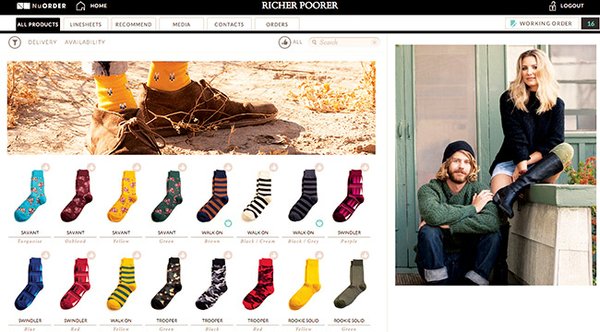
ONLINE SALES: A Richer Poorer linesheet selection as shown on NuOrder’s platform

ONLINE SALES: A Richer Poorer linesheet selection as shown on NuOrder’s platform

TECHNOLOGY

Business-to-Business Technology Solutions for Fashion Are Gaining Traction

By Rhea Cortado | Thursday, November 21, 2013

photo

NuOrder

Walk down the trade-show aisles 10 years ago, and most likely every desk had a stack of paper order forms. Today, it’s more common to see customers tapping an iPad to take notes and place orders through an application such as NuOrder. The splashy company’s online wholesale ordering platform is as intuitive as online shopping, yet it’s built with special features that retail buyers require. Drag-and-drop reordering of chosen items for merchandising and browsing lookbooks, videos and press clips are easy to navigate.

Heath Wells, co-founder of NuOrder, said many brands that use NuOrder to communicate with buyers notice increased sales. “The salesperson has more time to service clients” instead of being inundated with data entry, Wells said.

A few competitive companies that offer a service that’s similar to NuOrder—albeit each with its own specialized features—are Joor and Brandboom. The glossy and beautiful page design of these sites is a novel approach to business-to-business (B2B) sales, but the systems behind the shiny exterior is not an undiscovered concept in the wholesale industry.

“It’s like the fashion industry woke up to this,” said Michael Penchansky, founder and chief executive officer of technology company Monkey n’ Middle, which offers a B2B system that is used by companies such as Echo DesignThe Jones Group and Kenneth Cole. Penchansky was a veteran in the wholesale footwear business before he segued into technology.

“We aren’t about eliminating pen and paper,” said Penchansky, referring to handwritten paper orders. “What we are about is automation of the process.” That means when a customer logs into the manufacturer’s wholesale e-commerce website, it appears just like a retail e-commerce site except with wholesale-ordering capability. Penchansky said many of the front-end ordering companies are fantastic for the sales force, but not all of them integrate the buyer’s order with all the manufacturer’s internal systems—such as its enterprise resource planning (ERP), product lifecycle management (PLM), electronic data interchange (EDI) and third-party logistics (3PL)—neatly. Monkey n’ Middle said it can do all of the above.

“I love that there are companies like NuOrder and Joor because it just strengthens the importance of B2B in the fashion industry. It all depends on what the company is looking for,” said Penchansky, who said he has referred potential clients to both of those platforms. Penchansky added that Monkey n’ Middle targets clients that operate in the $100 million-and-up range.

FDM4 is experienced in providing ERP, warehouse management system (WMS) and customer resource management (CRM) solutions for activewear brands and has offered a B2B e-commerce division for about 14 years. FDM4’s strength is that its e-commerce portal connects to all of FDM4’s back-end operations, eliminating double entry of information and ensuring integration throughout the whole pipeline from viewing live inventory in different warehouses to shipping products from multiple warehouse locations to multiple retail locations.

“The e-commerce application reads the data directly from the ERP system,” said Mike Cutsey, president of FDM4. “If you launch a catalog on the ERP, you turn on a color or a style, there’s no uploading, no downloading [to the e-commerce site]. When you change the ERP pricing, the e-commerce pricing automatically happens.”

Finding the right fit

For brands that are not yet functioning at the capacity to require all of the features that the huge, complicated systems provide, there are several software solutions that cater to small to mid-size businesses.

Some brands purchase different system services a la carte. Iva Pawling, co-founder of Capistrano Beach, Calif.–based boutique sock line Richer Poorer, employs two systems to satisfy her company’s B2B needs: NuOrder—for taking notes, placing orders at trade shows and sending follow-up linesheets—and Hubsoft as a “light ERP” system.

Pawling said that Hubsoft is indispensible for its ability to streamline all of the back-end functions to manage and fulfill orders. That includes running multiple warehouses simultaneously, bundling products together to create pre-packs, customize wholesaler’s profiles, customize the workflow with its warehouse, customize all reporting and easily integrating into the accounting system.

Hubsoft also offers a dealer interface system in which buyers can place orders, but Pawling said one of the reasons she signed up for NuOrder is because many buyers were already familiar with the system. She sympathized with the fact that it’s confusing for buyers to learn multiple new systems when each vendor uses a different platform.

Still, she said that only a small percentage of buyers are submitting their orders through NuOrder outside of trade-show walls. In some cases, buyers use NuOrder to compile an order and then still submit the actual order via fax or email to the sales rep instead of through the platform.

“People just get really comfortable in the way that they do things, and to ask them to do any other system or to change their behavior is the hardest thing to do,” Pawling said.

Lee Decker said that he started Hubsoft to function as the missing technological link for brands on the sales side of the house.

“With the ERP systems, they have only technologically enabled half of their organization. The salespeople are still struggling with reports,” Decker said.

Hubsoft’s client base includes many brands in the actionsports market such as StanceOlukai and O’Neill that manage orders from multiple regional sales reps, team riders, B2C e-commerce sites and employees. In addition to its extensive sales reports and order-status visibility on the Hubsoft platform, reps can reference in-depth technical features of each product through extensive online training clinics.

Decker said that many brands falter because they cannot service their buyers operationally once the order is in hand and advises growing small businesses to get the back of their house in technological order early.

“If it’s easier for people to submit orders to you [as a brand], that’s very valuable to your customers. To have that portal in place saves you a lot of time operationally. It’s that much easier for buyers to trust their open-to-buy dollars with you,” Decker said. “Order capture is one process.”

Posted by Paul Brindley
on November 14, 2013

The Apparel News Article – Service Minded: Trade Shows Gear Up to Draw Attendees to the 2014 Shows

Here is an excellent article from the November 14, 2013 online edition of Apparel News.


TRADE SHOWS

Service Minded: Trade Shows Gear Up to Draw Attendees to the 2014 Shows

Wednesday, November 13, 2013

With a recovering economy underway, trade shows are poised to see increased attendance in 2014. California Apparel News checked in with several trade show organizers to see what new programs they have in place to attract new and returning attendees. Some are expanding their buyer amenities and incentive programs. Others are offering retailers more opportunities to research the market before the show. And some are highlighting their seminar programs and entertainment offerings, or remerchandising the show floor and adjusting the schedule.

photo

Tom Florio, Advanstar Fashion Group

Tom Florio

Chief Executive Officer

Advanstar Fashion Group

We’ve built a retailer-relations marketing team over the last two years. Pre-show, the relations marketing team is speaking to all the key retailers we do business with, really on an ongoing basis. If there are acquisitions going on, if there are new departments being launched—like a footwear department or a new men’s department—our retail-relations team is aware of it. As we’re walking around the world finding new brands, we’ll start feeding [retailers] brands. We’re working with them all the time, so there’s this ongoing dialogue. As we get closer to the show, certain retailers—particularly the larger ones—they’ll send us what it is they’re looking for, and we will start to plan their show for them.

We also have an overarching marketing campaign that markets MAGIC Market Week internationally. We don’t market MAGIC as a trade show; we market it as a contemporary market week for men’s, women’s and sourcing made up of 10 shows. There’s a multilingual direct-mail and advertising campaign that’s underway pre-show. Last show we had a 35 percent increase in our international buyers, and we’re also seeing an increase in e-commerce.

Each of the individual shows and the show directors have their own targeted database [and a] marketing campaign that goes out to special retailers [talking] very specifically about initiatives taking place on the show floor.

The other pre-show opportunity this year will be with Shop the Floor. All of our brands will have the opportunity to upload their looks on Shop the Floor about six weeks [before] the show actually starts, and our retailers will be able to go on Shop the Floor to preview collections, set up appointments and even do e-commerce if they want.

Even though everyone was running to the digital space, the idea of doing business in this space is a relatively new idea. I see Shop the Floor as an extension of MAGIC Market Week, which allows people to sell through business cycles. We’re pleased with the way it’s rolling out, but we’re surprised to see how comfortable people are in the traditional way of doing business—the brands as well as the retailers. It’s the fashion business—people want to speak to the people they do business with.

A lot of brands depend on the show. If you’re working with premium brands, they’re very protective about who sees their [collection]. Our system is a closed system. You’re only able to look at these sites if you’re a registered retailer at MAGIC Market Week and we really know who you are. We’ve added a mechanism, at the request of our brands, that [allows them to] select retailers because they want to decide what distribution channel they’re going to be in. At the last show, we went from 30-some-odd percent of our buyers using our apps and our digital platforms to 64 percent of them using our apps and our digital platforms. There seems to be some adoption, but it’s going to happen over time.

Overarchingly—and we get this from our post-show data—the No. 1 thing that drives retailers to a show, when you really cut to the chase on it, is they want to conveniently do business with the brands that they do business with. They want it to be easy to see the brands, and they want to be able to do commerce. The second thing they’re looking for is to see new brands.

Our show is made up—across all of our shows—of about one-third new brands to the show, and the remainder are [well-established] brands.

This is going to be particularly important this year. There’s a lot of talk about how promotional the holiday season will be. Buyers may be a little more cautious. They’re going to want to do business with brands they can trust, that they know will be behind them in case they don’t get the sell-throughs they want. New brands in those same environments with those existing brands have a better chance of being seen.

On the show site, there are a number of initiatives that take place. We have probably one of the largest seminar series at any trade show. It spans everything from sourcing to how to merchandise your booth. The education series continues to be a really big draw for the retailers.

And then there are show initiatives taking place across all the different platforms. An example would be at WWDMAGIC, there’s a trend report that takes place with Hal Rubenstein, the former fashion editor of Instyle.

Also, White, which is part of WWDMAGIC and moved out of the North Hall last year, will move back to the North Hall to make it easier for the buyers to get around.

Our whole initiative is to make it as convenient as possible for the retailers to shop across all our shows. Part of the way we’ve done that is the way we organize and curate and merchandise our shows. We continue to invest in what we refer to as “wayfinding” and attaching the wayfinding to transportation. The response from retailers in the last show [was] that it was much easier to get around the show.

We’re going to continue this evolution [by] setting up all of the MAGIC Market Week sites in an easily recognizable way. You can come off a bus or your town car and rather than just see the name of the show, you’ll be able to see womenswear is at the following shows, here are the classifications, [or], footwear is at the following shows, here are the classifications.


photo

Olivia Reyes, California Market Center

Oscar Ben Rodriguez

Senior Trade Show Manager

Olivia Reyes

Trade Show Manager

California Market Center

In 2014, we will officially have Sunday starts for all LA Fashion Markets and corresponding trade shows at the CMC. We have shifted our market dates to better accommodate our attendees’ schedules, providing more-flexible times to visit, so they are not just during the week. We experimented with a Sunday start in October 2013, and it proved to be a success, so we look forward to continuing this through 2014.

We have increased concentration of resources under one roof. We are seeing significant crossover traffic among all types and categories of buyers in our building. We foresee this as a continued trend for the next year as creative merchandising in retail continues to upswing. Furthermore, in addition to our thousands of permanent resources in the building, we will continue to bring well-rounded groups of exhibitors to each of our trade shows, providing buyers with unmatched resources all in one place.

Through our continued travel program, our buyers will be able to take advantage of discounted hotel rates, complimentary shuttle services and other convenient benefits to make their travels to LA more enjoyable and easy.

We will continue to strive to create a productive and enjoyable shopping experience at the CMC to all our buyers through continued complimentary hospitality, Internet lounges, giveaways, special events, Market Tuesdays and much more. Furthermore, by continuing our partnerships with prominent industry forecasters and affiliates, we will be able to deliver insightful and relevant topics as a part of our ongoing retail seminars and discussion panels.


photo

Andrew Olah, Kingpins Show and Olah Inc.

Andrew Olah

Founder/Owner

Kingpins Show

Chief Executive Officer

Olah Inc.

We are very excited about 2014. It is our 10-year anniversary, and it marks the debut of our first-ever European show, Kingpins Amsterdam, which is set to run May 7–8.

Every year we continue to tailor each show to meet the individual needs of the cities and markets we service, but one way that we boost attendance at every show is to offer seminars. Whether focusing on trends, finance, sustainability, cotton prices, the creative process or technical information for product development, we find that our attendees are highly motivated by information, education and inspiration.

So, beyond offering a better range of denim sourcing resources at every show, we also look to up the caliber and creativity behind our seminar offerings season after season.


photo

Sam Ben-Avraham, Liberty Trade Fairs

Sam Ben-Avraham

Founder

Liberty Trade Fairs

As an individual show, our job is always to make sure we have all the relevant brands—a mix of the staples, fashion-forward and trend-based brands. It’s important to us that buyers see their existing accounts but also find something new at our show. At Liberty, we understand and live the market, and that’s what sets us apart from other shows.

We also understand one trade show cannot service every segment of the market without diluting its individual identity. This is why Liberty has aligned with other great shows with the same point of view, each an expert in its own market category. The Modern Assembly consists of Liberty, Capsule, Agenda and MRket and lives under one roof at The Venetian. We understand that our job is to service the industry and the buyers in the best way possible. By uniting, we’ve created one destination providing solutions to nearly every relevant store in the contemporary denim and designer category.


photo

Judy Stein, Miami Swim & Lingerie Show

Judy Stein

Executive Director

Miami Swim & Lingerie Show

As always, we are tremendously excited about next year’s show. As you know, the Swimwear Association of Florida produces an annual four-day event titled SwimShow, which is the largest and most comprehensive swimwear trade show in the world. This event has made Miami Beach the No. 1 destination for the swimwear industry.

Each year, over 8,500 designers, buyers, manufacturers, press, and other industry leaders come to Miami Beach in the middle of July—not only to participate in this dynamic, valuable business opportunity but also to enjoy the hotels, nightlife, restaurants and entertainment aspects that this fun city has to offer. We host several programs during the event, including:

•Trend-forecasting seminar

Always on the cutting edge of industry insight and information, SwimShow will team with one of the world’s leading fashion and style-forecasting organizations to provide comprehensive trend reports for designers and buyers that will give them the vital advantage of an insider perspective. The seminar will dive into the latest trends seen on runways, trade shows, streets and retail shops and will pinpoint key beachwear concepts, colors, materials and details—all for the Cruise and Resort 2015 buying season—giving attendees an insight into the seasonal trend reports that will assist in reducing risk, saving time and making money.

•Fashion show and after-party

Each year, SwimShow generates wild enthusiasm for the upcoming Cruise/Resort season with the glamor of the highly anticipated runway show. The annual event will be held on-site in the [Miami Beach] Convention Center for the ease and convenience of our retailers and members. The SwimShow Fashion Show is a dazzling highlight, featuring a look from each of the participating brands in the trade show. It is an amazing lineup of the industry’s most exciting designers. The after-party is a great way to top off the evening with delicious bites, cocktails and entertainment.

•Swim lounge

SAF invites our members and buyers to relax and unwind in our luxurious swim lounge area. Replete with comfortable sofas and armchairs, the space is perfect to take a quick break or utilize the tabletop seating for a more discrete business conversation. Free Wi-Fi is available for all their needs. Plus, participants and retailers enjoy a Saturday and Monday evening happy hour from 6 to 7:30 p.m.

•Breakfast bar

The breakfast bar—featuring complimentary coffee, muffins and bagels—is open daily from 9 to 10:30 a.m. at the Convention Center and is the perfect way to start out each day.

•High tea

Featuring complimentary fresh fruit, biscotti and mini tea sandwiches, the high tea is the perfect way to add that afternoon kick.

• Informal modeling

This year the SwimShow will bring back informal modeling to the trade-show floor. Scheduled for each mid-morning of the show, this is a great way generate brand awareness and potential leads for participating swimwear companies.

• Design awards

We are also in the finalizing stages of announcing the First Annual SwimShow Design Awards, sure to be heralded as the “Oscars” of the swimwear industry. We will award recognition in the following areas: Swimsuit of the Year, People’s Choice Award, Best Full-Figured Suit of the Year, Best Active Wear of the Year, Best Girls’ Swimsuit of the Year, Best Men’s Swimsuit of the Year, Best Boys’ Swimsuit of the Year, Best Lingerie of the Year, Best Cover-up of the Year and Most Innovative Swimsuit of the Year. Products will be chosen from the samples that are sent for inclusion in the SwimShow runway show, and winners in each category will be announced at the end of the show.

•Social media

Last year’s social-media integration initiated interaction with buyers, exhibitors, media and swimwear lovers alike, reaching more than 1 million Twitter and Facebook users in just a few short weeks. We are in the process of developing this platform to become a comprehensive tool to build and grow our targeted attendees.

• International buyers

We have also partnered with the U.S. Commercial Service’s International Buyer Program to bring new international attendees to the show. The International Buyer Program recruits qualified foreign buyers, sales representatives and business partners in more than 80 countries to participate in U.S. trade shows each year.

•Media-sponsorship agreements

In addition, media-sponsorship agreements were generated with national and international publications that are considered to have the highest circulation and credibility within the swimwear and lingerie industry. Running in conjunction with our ongoing public-relations campaign, these publications will be running ads and featuring news stories about SwimShow on a regular basis.


photo

Ed Mandelbaum, Designers and Agents

Ed Mandelbaum

Co-founder

Designers and Agents

D&A has been—and remains—the most significant trade-show destination in Los Angeles for the past 15 years and continues to present the strongest selection of both emerging and established brands as well as creating a great environment for both exhibitors and retailers to conduct business.

Designers and Agents also continues its longstanding commitment to sustainable, ethical and fair-trade design practices with its “green” programs, which provide support and exposure to those brands that meet the necessary criteria.


photo

Pierre-Nicolast Hustel, CurvExpo

Pierre-Nicolast Hustel

Chief Executive Officer

CurvExpo

After a successful 2013 season, CurvExpo is very excited for 2014. It is important for us to keep the anticipation of each season high with new and exciting programs as well as retaining our loyal attendees and giving them reason to keep returning.

Our attendees are our priority. We have so many devoted attendees. It is important that we maintain our dedicated customer service and an all-inclusive experience. We are a focused team here at CurvExpo, and, as such, we can promise that all needs and/or concerns be met with tremendous care and a personal guarantee. We also offer our attendees an all-inclusive trade-show format. For example, we make the show feasible for our attendees by delivering a luxurious experience, offering breakfast and lunch; our partnerships with hotels can promise discounted rates; and, lastly, we can offer travel reimbursements (in Las Vegas only) to make the show as enjoyable as possible.

Further, we continue to keep our attendance high with insightful workshops for the buyers and trend seminars for the brands.

We continue to retain and attract our brands with an extensive marketing platform. We market our brands through all avenues of social media: Facebook, Twitter, Instagram (new this season) and Pinterest. We also have a dedicated newsletter issued every month to all our buyers that displays brand news and the lines they will see at the show. This year-round marketing platform starts the day a contract is signed and is a great tool for new brands to promote themselves in the industry and an extra boost for the established brands.

CurvExpo puts a lot of work into attracting new attendees with our brand partnerships and personal shopper services. We have great relationships with our brands that have proven mutually exclusive; as we help them, they help us to attract buyers they want to see on the show floor. Our personal shopper program gives the buyer a one-on-one experience with a member of our team. You tell us what you are looking for at the show, answer a quick questionnaire to help us understand your shop, and we will then consult and advise you on the best brands to visit during the show and who to book appointments with.

New to this season, we are thrilled to move forward with exclusive and informative events at each show, such as the Fashion Show and the Interactive Trend Wall. The Fashion Show will be an elegant event presenting fabulous lines in New York and Las Vegas. We are particularly enthusiastic for the new 8-by-15 Trend Wall, which will display fabrics, trends and lines from the brands on the show floor for a smarter shopping experience. This Trend Wall will be presented by Promostyl, and a consultant will be present to explain the benefits and how to use this to your advantage.

The highlight of 2013 was our New Accounts Program: “Love a new brand? Open a new account? Win a trip to Paris!” This program was a huge success at the shows, and we expect the same for the 2014 season. The program motivated buyers to “think out of the box” and search for a new brand. Likewise, the brands were excited as buyers were eager to meet them and work with them.

We have many reasons to keep our attendees coming back and much more to attract the new ones. CurvExpo is proud of the 2013 season, and we are working to grow and attract even more brands and buyers in 2014. We anticipate great shows for this season at both CurveNV Las Vegas Feb. 17–18 and at CurveNY New York Feb. 23–25.


Suzanne De Groot

Executive Director

Fashion Market Northern California

Fashion Market Northern California is fortunate to have many loyal buyers who come to all or many of our five shows a year.

That said, we are always looking for ways to encourage new buyers to come and enjoy the show and, of course, welcome anyone back who has not been to our market in a while.

We have recently hired a marketing consultant, who will focus on expanding our current website and Facebook and increasing our presence on other social-media venues. She will also be available at shows to demonstrate how to access and use social media as a selling tool—for both buyers and vendors.

We serve a complimentary breakfast buffet and lunch coupons to all buyers.

We have more than adequate (and easy) parking—with complimentary parking on Tuesdays at most shows.

We have extended our Monday hours to 7 p.m. and have wine and beer available during those hours, with complimentary drink coupons to buyers.

Every afternoon there is a complimentary cart with cookies and snacks, along with iced tea, lemonade and coffee.

We mail out a comprehensive show directory, linked to the website, which facilitates buyers making appointments in advance and planning their show time wisely.

We currently have a program to offer a complimentary night at the Marriott [San Mateo] to any first-time buyer who wishes to come to our show. This is time sensitive and subject to availability.


photo

Mary A. Essuman, Gerry Building

Mary A. Essuman

Gerry Building

We like to do what we can to help the market.

We have a sign outside the building that lists the showrooms inside. That’s one way that attracts buyers for market We also have complimentary breakfasts during market.

For market, we’re always open to having temporary showrooms. We have several showrooms—between 10 and 15—with room for temporary showrooms.

We had a lot of temporary tenants come in for the Majors Market and some for the LA Market [in October]. We had a really good overall response—especially for our [opening-night] party.

This time around, we’ll be doing some other signage and flyers. We’d like to do some kind of promotional party similar to what we did [in October], although there may also be a fashion show on the roof in January.


photo

David Lapidos, Offprice Show

David Lapidos

Executive Vice President

Offprice Show

We have instituted a loyalty program. Anyone who has attended any of our shows in the last two years will get a special rate at The Palazzo or The Venetian. Buyers will pay an Offprice rate of $199, which is $30 less than the hotel’s published rate. Also, we have increased our shuttle and limo business by 50 percent because we’re taking more people to more shows. As you know, there are a lot of shows that week. We are making a big step to accommodate everybody.

[We offer daily] New Buyer Tours. We take buyers out with a professional buyer [to tour the trade show]. He does this three times a day for the first two days and then once a day for the last day.

Also, we have upgraded our kosher food.

The last show was the first time we changed out floor plan, and people seemed very happy with it.

Our cash-and-carry section has mushroomed. We’ve got about 80 vendors.

Jeff Yunis

President and Owner of Specialty Trade Shows/organizers of WWIN (Womenwear in Nevada)

We’re one of the few that has not been affected [by the recession] Our show has been sold out for eight years. We just continue to do what we’re doing because we think it’s working.

We still do some snailmail and we do some emails and some faxes. And we get our exhibitors to work hard at making appointments and sending out information about the show to their clients. We put a lot of effort into making the exhibitors understand that it’s a partnership. When we send out an announcement mail, it’s propaganda. When they send it out, it’s one-on-one, seller to buyer. It’s a lot different when a store gets a call or mail from somebody they do business with trying to make an appointment than when they just get a blast email from us.

We give them free breakfast, free lunch, free snacks in the afternoon. But we have no room for seminars and fashion shows. It’s a show to do business. We impress upon buyers that this is a buying show. If they want to go sightseeing, they can go to the Grand Canyon or to MAGIC. If they don’t buy, the exhibitor has no reason to come back. We let people know they have to do their end of it. They just can’t show up and have a drink and schmooze and go home and send an order later. They’ve got to buy.

For that reason, we’ve got 855 booths at the show for the next show. We only have 19 left to sell, and our waiting list is half the size of the show.

We deal with specialty stores primarily. We do have Nordstrom and Ross Stores and TJ Maxx and all the catalogs [attending, as well]. But out of the thousands that come to the show, they make a small percentage. So we look after the small buyers. At our show, they feel they found a home, and that’s something we keep promoting. This is a place for specialty buyers. We make them feel very wanted. They never get pushed aside by big buyers walking by. When I used to go to MAGIC as a small buyer, the eyes were always out there looking for the big department store to walk by. At our show, that just doesn’t happen. The buyers tell us all the time that they feel comfortable, they feel at home. Everything we do is to make the buyers happy. Even though the exhibitors pay us, we realize that without the buyers we wouldn’t have the exhibitors. So we’re extremely buyer-oriented. That’s our way of doing business.


Aaron Levant

Founder

Agenda

We do a lot (to find new retailers). Our approach is multi-tiered. When we first started, it was [about] going out and banging on a lot of doors. We still keep that as part of the strategy today, 10 years later.

We have two people on the team who are dedicated to retail. They spend a couple weeks every season getting out there and going to retailers and meeting them personally. I personally go to a lot of retail stores. And everyone else on the team—we try to get to a lot of retail, especially in our backyard. We have to own our backyard and have that personal connection to people.

We do a lot of stuff with social media. I believe that we have the biggest presence in social media. That’s a big piece of what we do. It’s our generation.

We do a lot of unique print pieces and a multilayer email campaign and more traditional styles of marketing.

The No. 1 thing that we do that separates us from our other shows is our TAP program, which is our Targeted Attendee Program. And that is where we just spend money to help get key people out to the show. We basically poll our brands. They submit to us the retailers they would like to see the most. It isn’t just about buying power—buying power is definitely factored in—but also it could be influence.

It’s like a VIP program. It ranges from getting them hotel rooms to a car service to the show to flights. That is something we spend probably a considerable amount of the year on much more than other competitors.


photo

Eva Walsh, Dallas Market Center

Eva Walsh

Vice President, Business Development

Dallas Market Center

Coming off one of the most successful markets of the year, we are so excited about what’s in store for Dallas Market Center in 2014. We are seeing firsthand a recovering economy with increases in attendance and significant growth across the apparel marketplace in the year-end, with many factors reinforcing these positive projections in the new year across all industries. In fact, many of the categories for our January Temp Show were sold out, and others more than 90 percent sold, long before the official start of the fall—one of the many encouraging signs we’ve seen leading up to the January Apparel Market in Dallas.

In addition to providing a diverse, complete product offering, we’ve continued to expand our programs to offer the resources and education our retailers need to succeed from a business standpoint. Our buyers come to market to gain the competitive advantage whether it’s access to the hottest lines and networking opportunities or the many inspiring fashion shows and displays. And most importantly, Dallas is all about helping retailers receive the highest return on investment possible—something that has been increasingly important the past few years. Whether they are new to Dallas or a 20-year veteran, attendees will feel good knowing Dallas is the most efficient marketplace proving to be a strong value year after year.

All of these focus points add up to big savings for attendees in 2014.

•Service

We have an entire department serving as retail ambassadors, working to secure new stores and serving loyal buyers. Our retail-development team works hard to understand a retailer’s business needs and provide support. While at market, buyers take advantage of a full suite of complimentary services, including Wi-Fi, on-site parking, shuttle service to and from area hotels, and hospitalities. Dallas equips buyers with critical information throughout the year relating to marketing, social media, prospecting, etc.

•Location

Location, location, location—we’ve heard it all before. Well, it really does matter after all. Dallas is conveniently located in Mid-America—the strongest economic region in the U.S. And the costs of doing business in Dallas are lower than any other marketplace, so it’s a more reasonable investment. With a broad array of leading manufacturers calling Dallas home, buyers get business done across many categories more efficiently.

•Travel

We’re determined not to let travel costs detract from our customer’s bottom line. Being at the center of it all, literally, Dallas offers more direct flights and the lowest hotel rates of any major marketplace (as low as $78 per night)saving time and money.


photo

Guglielmo Olearo, Première Vision

Guglielmo Olearo

International Exhibitions Director

Première Vision

It is our duty to stay very close to the market, [which is] why our U.S. office is in close contact with loyal and potential visitors.

We welcome most of the important companies, but we also expect that due to the recovering economy young designers and new brands with big creative potential will come to us.

We have the capacity to provide them with all the tools to find the best products for their collections.

We continually evaluate our show to meet buyers’ expectations in terms of the offerings and services. The rigorous selection of exhibitors means that professionals are sure of finding a truly creative and high-quality offerings.

Our fashion team creates seminars tailored to the North American market, and the trends are illustrated by products presented by our exhibitors. This is a truly unique service!

The fabric forum, with exhibitors’ samples, also gives a very clear vision of the [show’s offering].

Outside of the shows, we regularly provide attendees with fabric and fashion news.

Before the show we do everything we can to give visitors the key to a constructive visit, to inspire them and facilitate their business.

Posted by Paul Brindley
on October 24, 2013

Los Angeles Fashion Market Week Spring14 Review – Snap, Crackle …. Pop?

There was plenty of buzz at last week’s Los Angeles Fashion Market Week for Spring14.

What is Market Week? It’s when the seasonal business of fashion happens in the The New Martshowrooms and trade shows of the main wholesale centers: the California Market Center (CMC), The New Mart, the Cooper Design Space, The Lady Liberty Building, The Gerry Building and other venues in the Fashion District that is centered on the intersection of 9th and Los Angeles Streets in downtown LA.

This is not the glitz and glamour of the fashion business. This is not Fashion Week, it’s Market Week. The runway shows are done, the cocktail parties are over, it’s now down to the business of buying and selling the fashions that you see in stores and online starting in early 2014.

The Spring market in October and Fall market in March are the two main weeks of the year. It is expected that there will be plenty of activity, and I’m happy to report that last week there was.

An expanded schedule of trade events was staggered from Sunday, October 13 through Thursday the 17th.

The CMC and Gerry Building showrooms and temporary trade shows held market from Sunday to Wednesday. The New Mart, the Cooper Building, and the Lady Liberty ran theirs from Monday to Thursday.

The temporary trade shows were:

This Market Week saw the launch of the new menswear-focused Los Angeles Men’s Market on the 4th floor’s Area 4. LA Men’s Market is a collaboration between four of the most prominent LA men’s showrooms:  The NTWRK Agency, The Park, The Foundation, and Flagship Agency

LA Men’s Market

The 2-day event ran Monday and Tuesday. As well as the four founding showrooms, brands showed in temporary (because they are unused) showrooms on the 4B side of the CMC, known as Area 4.

Area 4 is permanent home to some top quality showrooms such as, NTWRK, Derelicte, and Market, and was supposed to be a focus of men’s contemporary and street/lifestyle fashion. The 4B floor was redone a few years back with a staircase cut through from the women’s contemporary 5B but due to the economic times, the concept has not taken off. Apart from some excellent, mainly men’s showrooms, it is a bit of a ghost town. But it’s a great space for a temporary show like LA Men’s Market.

It sounds like the attempt to focus buyers worked. Transworld Business quoted The NTWRK President and LA Men’s Market co-organizer Kellen Roland as saying, “It was a huge success. We saw triple the amount of buyers we’ve seen in previous men’s markets. I believe we accomplished our goal of bringing men’s market back as a viable place for brands and buyers to do business.”

These things take time but if the first go-around was such as success then the concept is here to stay and can only grow as other brands sign on.

Designers and AgentsThe floor at D&A LA

The D&A show on the 3rd floor of the New Mart was full. There were about 100 booths showing 150 brands.

Monday was a particularly busy with business tapering off over Tuesday and Wednesday.

Some of the highlights for me were:

Christy’s Hats new range of crochet hats for men and women.

Christy's new range of crochet hats

Christy’s new range of crochet hats

Sales Manager Ben DeLuca is having a strong Spring selling season. Many buyers are still wanting Fall goods and ordering closer to delivery (I heard this from a number of agents during the week). The new crochet range is booking well along with Panamas for men. Ben sees an overall improvement in the market from earlier this year.

Calleen Cordero Designs‘ semi-precious stone, metal, recycled textile and leather cuffs and bangles for women. Made in LA.

The Turquoise Cab Cuff features solid nickel and brass hardware.

The Turquoise Cab Cuff features solid nickel and brass hardware.


The colorful recycled material and vegetable dyed bags of Italy’s Essent-ials.

20131016_141139

Essent-ials

The bags come in 2 sizes for $21 and $25 wholesale with the vegetable dyed at $28. Some have adjustable straps that can be worn over the shoulder or as a sling. The material is sturdy and great to the touch. This should be a winner in the market.

Pyrrha‘s reclaimed sterling silver or bronze jewelry that is hand cast from 18th and 19th century wax seals, Victorian keys, and use semi-precious facetted stones. Each piece is handmade in Vancouver.

Pyrrha hand cast pendants


Cooper Design Space

The deco Cooper Design Space lobby

Next it was off to the Cooper to check out the two shows on the 11th floor, the accessories show Coeur and contemporary women’s Brand Assembly.

The lobby at the Cooper was bustling and the elevators were busy and full. I bumped into Brad Jaco, the owner of Namaste Showroom. Brad was having his best market “for a long time”, and was seeing lots of new stores.

The 11th floor is a 20,000 sq. ft. white space with a high ceiling and floor to ceiling windows which flood the space with natural light which makes for a perfect trade show venue.

For the first time, Brand Assembly and Coeur were sharing the space.

Exhibitors were pleased with the increased traffic that was generated by having both run concurrently. Meredith Hazan, the owner of the jewelry and accessories showroom, Maritime Showroom, who has done all 5 of the LA Coeur shows, told me she saw buyers that she wouldn’t have otherwise seen.

Brand Assembly

The floor at Brand Assembly

The very contemporary women’s trade show Brand Assembly continues to flourish with each iteration. Exhibitors increased to 39 booths and 60 brands.

Hilary France, the Co-Founder and CEO, was very happy with the activity and vibe of the show. “I love the positive, light filled space. The energy between the different exhibitors is very positive as many know each other well. We’ve had great synergy with Coeur. There are no crossover brands and there is a value add for buyers being exposed to new brands.”

Nearly 500 quality retailers attended including: Saks, Intermix, Shopbop, Bergdorf’s, Kitson, Scoop, Ron Herman, Revolve, Elyse Walker.

With the expansion of the show, increasing interest from brands and the dedicated following from sought-after buyers, I asked Hilary about her plans for the future. “We will keep the show exclusive, curated and selective. We have fantastic brands that play well off each other. We are planning a New York show for February ’14, and possibly going back to Paris for a show in March”.

Elizabeth Lewis, owner of The SYDNY showroom who has been doing Brand Assembly since it’s start-up on the Mezzanine of The Cooper, was very happy with the quality of buyers that she had worked. The SYDNY represent the Australian brands, blessed are the meekand she wasTigerlilyEbony Eve.

I asked Elizabeth about the benefits of doing Brand Assembly after buyers had seen the collections in Las Vegas and New York. Elizabeth said that she gets to work west coast stores that don’t do Vegas or NY. She sees buyers from all along the west coast, the south west and Hawaii.

I spoke to Megan Flynn of Black Halo, who have recently taken sales in house. Megan had been very busy working some of the accounts mentioned above and as well as MGM and a noticeable amount of Colorado accounts. I met Megan through Boxie designer and my bestie, Tracy Engelien who had worked with Megan in a previous life.

Mila Hermanovski at Brand Assembly

Project Runway winner, Mila Hermanovski was having great success with her own label, Mila Hermanovski. Mila has had strong sell-through in her second season. She is known for her leggings which have become popular with the bigger accounts.

Bi-coastal showroom, The Out Crowd were showing Australian brands: Shakuhachi, Friend of Mine and Tallow.

Another collection that stood out (and one of Hilary’s personal favs) was Nonoo.

Designed by Fashion Group International’s Rising Star award winner, Misha Nonoo, this very wearable collection blends classic styles and strong structures with an eye-catching color palette and fun, sportswear inspired prints.

Nonoo at Brand Assembly

On the Couer side of things, I loved the sterling silver and natural un-dyed gems and crystals used by Joseph Brooks in his incredible jewelry collection. I see a lot of semi-precious stone jewelry on my rounds but Joseph Brooks stands out. Joseph uses the energy and beauty of the stones to create pieces from stone and bone prayer bracelets to hand cut, pointed stone pendants that can also be used as healing pendulums to belt buckles and cufflinks. Joseph has a star studded celebrity following.

The general consensus was that the Spring14 LA Market Week was a big success. The momentum of the trade show circuit that started in Las Vegas in August and has run through New York continued on to LA. We’ve had the Snap and Crackle of the Spring selling season, now let’s see if we get the Pop at retail when these styles hit the floors in January.

Paul Brindley

paul brindley consults